
Looking back at her first solo exhibition at StolenSpace Gallery, we caught up with Goto to discuss her creative process, childhood dreams and the cultural and spiritual beliefs that imbue her practice with presence and meaning.
For artist Goto Atsuko, painting itself is a form of dreaming. Her time studying in Paris (2007-2009) and the profound impact of witnessing the 2011 Tōhoku earthquake greatly inform her practice. In her imagined landscapes, she reflects on cultural virtues of selflessness, resignation, and obedience that, beneath their quiet surface, carry an undertow of desperation.
Her compositions unfold as beautifully unsettling visions: ghostly figures entwined with nature, embodiments of the emotions that move beneath both the conscious and unconscious mind. Dark tones pierce through muted palettes, underlining the transience and fragility of life, and at the heart of these spectral worlds are guuzou: idols, empty vessels onto which desires, prayers, and curses are projected. While some may worship talents or virtual characters in today’s rapidly shifting culture, these objects remain only variations of the same empty guuzou. Like the dream that unfolds beyond conscious control, the guuzou resists alteration: loved, feared, yet forever untouchable.
What does your creative process look like? Could you walk us through the journey of a piece, from its initial spark to completion?
I usually take notes on things that interest me, words that catch my eye, events close to me, and news from Japan and abroad. I think about what moves me emotionally and inspiringly. When I decide to paint something, sometimes I have a clear theme, and other times it's vague.
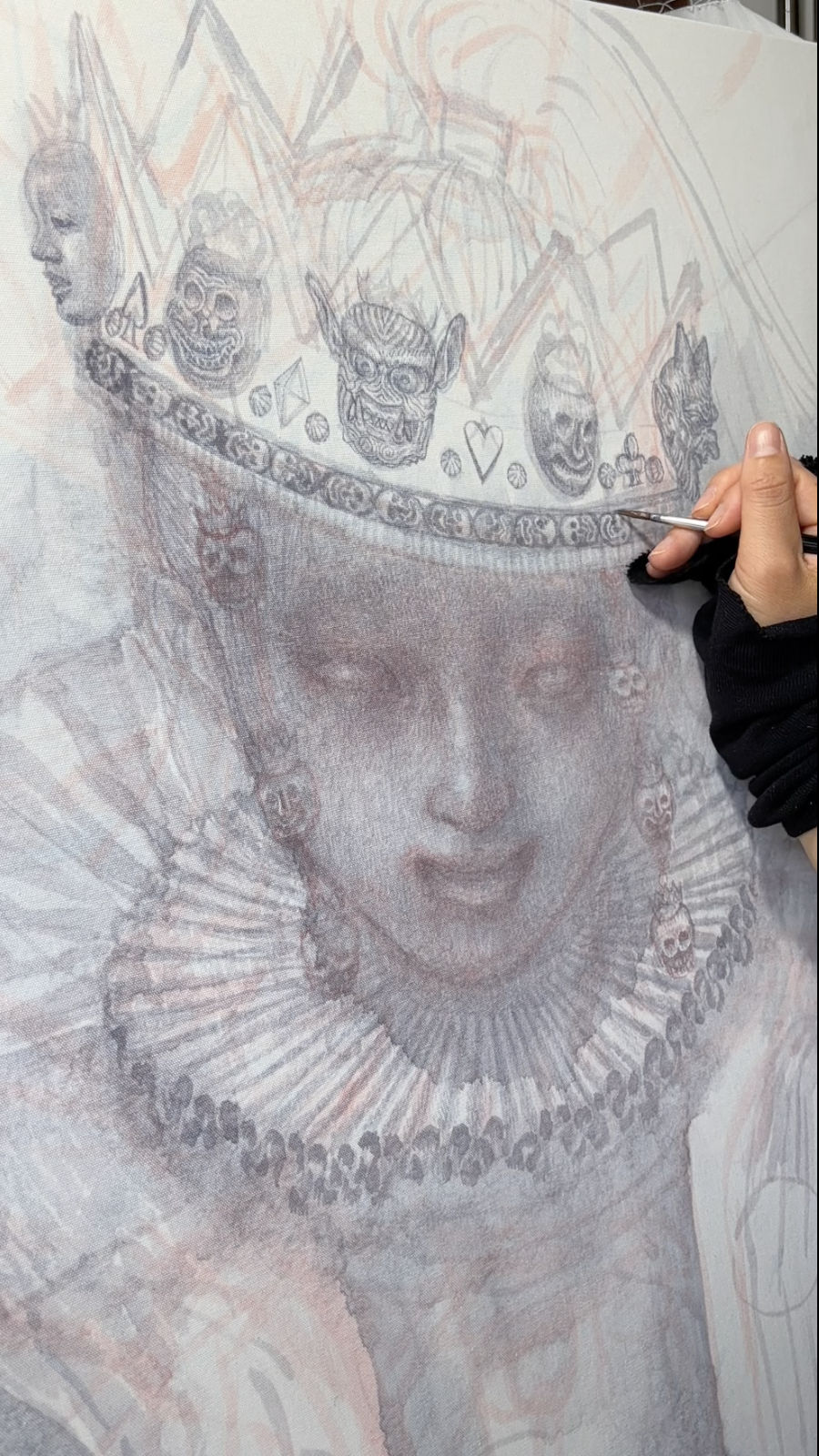
I search for ornaments, weapons, and clothing from art museum archives around the world, mixing and arranging pieces from various regions and eras to incorporate them into my paintings. As I paint, I consider the overall balance, adding elements and thinking about colours.
Either way, I start by drawing a rough sketch. Then, erasing and painting, I search for a way to connect with my sensibilities and see if what emerges on the canvas resonates with my sensations at that time. If I feel something is good, I begin painting without deciding on the details, incorporating my current sensations into the painting. I decide the details as I paint. Because I paint by soaking the paint into the fabric, it is impossible to completely erase the paint once it has been applied, but because I work with very diluted paint, I can make corrections as I go. I make watercolours by mixing pigments with gum arabic. Increasing the amount of gum arabic allows me to create transparent layers of colour. In addition to synthetic pigments, I also make paints using natural mineral pigments (powder made from crushed rocks, which has coarse particles and good colour development), as well as gold and silver powder. I also use paint refined from real lapis lazuli, carefully layering it to create a thin film to create the texture of the figures' skin. (I prepare a lot of paint in advance and dissolve it in water only as needed.) I search for ornaments, weapons, and clothing from art museum archives around the world, mixing and arranging pieces from various regions and eras to incorporate them into my paintings. As I paint, I consider the overall balance, adding elements and thinking about colours. I'm not sure if it's finished, but I consider a piece to be complete when I feel like I can't paint any more.

What do you listen to when you’re in the studio - music, silence, or something else? Are there any artists or sounds that influence your creative atmosphere?
When I'm creating, the music I listen to changes depending on the stage of the painting. I often prefer complete silence at the beginning, but when I'm working on the long, detailed parts of the final stages of production, I often listen to up-tempo music like pop, or anime or dramas (with a lot of auditory information and dialogue). I also listen to storytelling on podcasts or the radio. When I find music that syncs with the work I'm drawing, I sometimes listen to it over and over again. I discovered the music of J.A. Caesar (the composer who worked on film and stage music for Shuji Terayama) when I was in junior high school, and it had a big impact on me, and I still listen to it today. I also listened to a lot of classical music when I was younger. I particularly like Stravinsky's "The Soldier's Tale." I also often listen to piano pieces by Chopin and Debussy.
Your chosen materials and application methods give an ethereal, almost translucent quality to your work. Could you talk about a specific piece where you explored this approach, how you arrived at it, and what aspect of working in this way you most enjoyed?
I began painting oil paintings in high school in preparation for the entrance exams to Japanese art university. I continued painting oils throughout college, but at some point, I began using them as if they were water-based paints. After studying art materials in the Tokyo University of Arts and studying abroad in France (Ecole des Beaux-art de Paris), I came into contact with a variety of materials and one day, by chance, discovered the technique of painting with watercolours on cotton fabric. This technique perfectly suited my temperament and nature, and it gave me a mysterious confidence that simply painting would become "my own painting." It's incredibly exciting and moving to witness the phenomena that occur when the cotton fibres, water and paint particles, and my own senses intertwine.
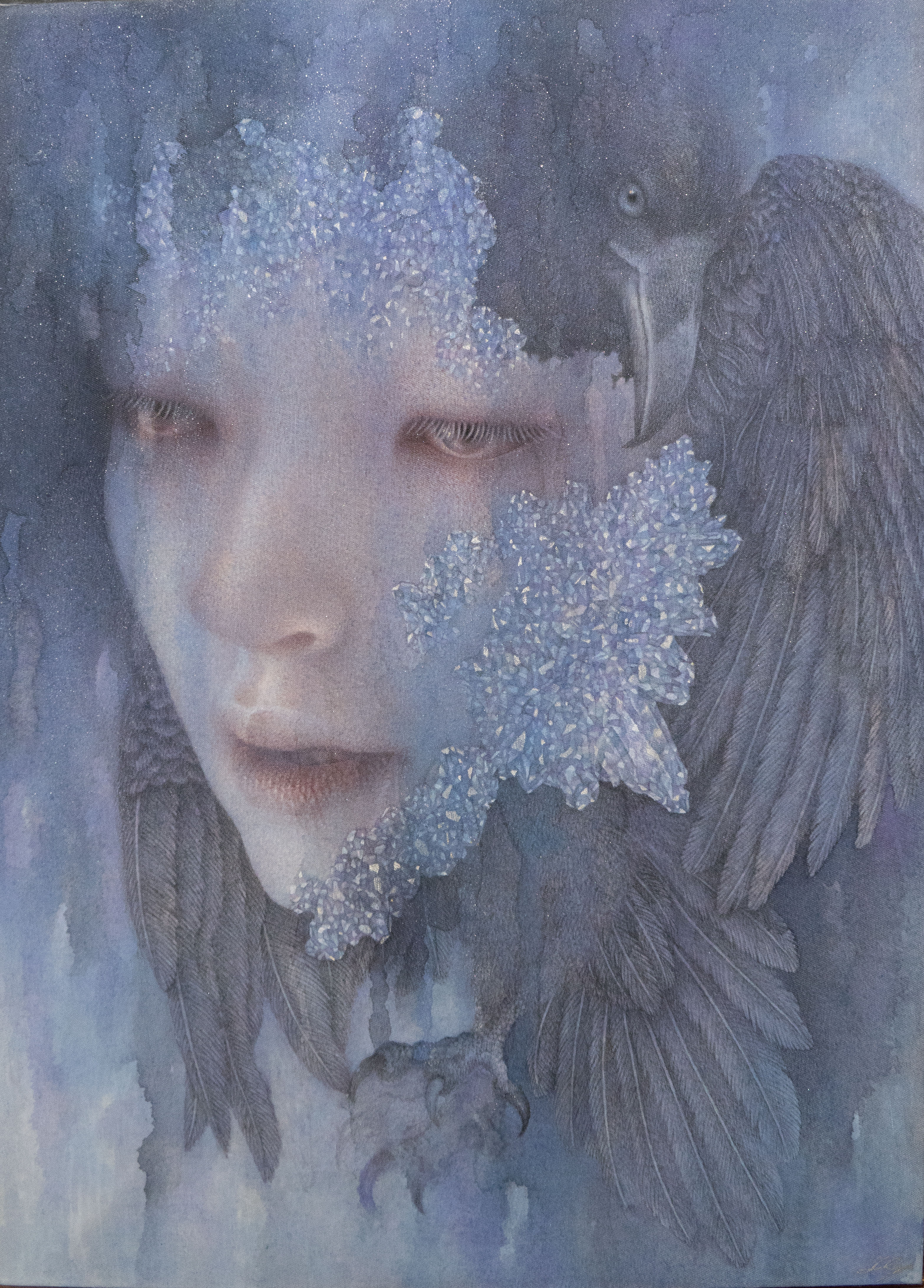
I believe that everything is two sides of the same coin. Life and death, hope and despair may seem like two opposing things, but I see them as one. I want to express things that contain opposing things.
Your figures personify dreams, passions, prayers, and even curses. How do these inner experiences - whether a dream you’ve had, or a prayer or curse you’ve released - manifest in your work? Could you share one that has lingered with you, perhaps even from childhood, and how it continues to shape your artistic practice?
Your work examines the balance of existence: beauty and decay, hope and despair, life and death. How do you see the goddess of creation and death reflected in your practice, and what draws you to this duality?
Solitude and emptiness are central themes in your practice. Do you see these as pathways toward connection or spiritual reflection, and in what ways has Shinto shaped how you perceive and depict the world in your art?
Often, the figures in your work are women. What role do women play in your cosmology, and why do they carry these prayers, dreams, and burdens in your work?
